
League of Legends Settings LogicEditorial
LoL is a MOBA: your mouse is a pointer tool, not an aiming tool. That single fact reshapes the whole config. First, DPI runs high — the modal value among the 104 pros with a recorded DPI is 1600, and the median sits at 1500, versus the 400–800 you see in tactical shooters. High DPI is not sloppy taste; a LoL match needs you to flick across a full 1080p board dozens of times a minute for abilities, minimap and targets, and a higher native DPI makes that long-range pointer travel cheaper on the wrist. Second, resolution is near-uniform: 98.8% of recorded setups run 1920×1080, because it is the standardised tournament resolution and the aim-precision that matters in FPS never applies here. Third, and this is the part most guides skip — LoL exposes two independent sliders, a 0–100 cursor speed and a separate camera-move speed. A player like Faker sets both to 65; a top laner like Zeus runs cursor 55 / camera 50. Those are pointer-trading preferences, not a sensitivity you can convert to another game.
What DPI They Actually RunVerified data
The OutliersEditorial + data picks
- ShowMaker runs 2500 DPI on a Logitech G Pro X2 SUPERSTRIKE — roughly 1.5× the modal 1600, among the higher published values. Extreme high-DPI pointer setups suit players who rest the hand near the pad edge and drive with small wrist snaps.
- Caps and Larssen both sit at 3200 DPI, confirming the upper band is a real cluster (Razer Viper and GPX shapes), not a one-off misread.
- At the opposite end, deokdam runs 400 DPI on a Razer Viper V3 Pro — the lowest value on file (only six recorded entries sit below 800), effectively forcing the in-client cursor slider to do all the pointer-speed work.
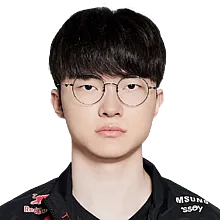 FakerT1 · Mid
 ZeusHanwha Life Esports · Top
Mainstream GearVerified data
| Family | Pros | Share |
|---|---|---|
| GPX | 51 | |
| Viper | 30 | |
| DeathAdder | 15 | |
| G305 | 7 | |
| SUPERSTRIKE | 4 | |
| Lamzu | 2 |
Top pads (148 records): Razer Gigantus V2 (31), Logitech G840 (18), Logitech G640 Original (16)
Copy-a-Pro SetupsVerified setups
FakerT1 · MidZeusHanwha Life Esports · Top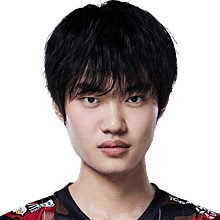 knightBilibili Gaming · Mid
How to Apply ThisEditorial
Step 1. Set your mouse to the DPI tier first, not the in-client slider. The modal pro value is 1600 DPI — configure that in the mouse software so pointer speed is hardware-consistent across every app, then leave Windows pointer acceleration off.
Step 2. Run 1920×1080 if you can. 98.8% of recorded pros do, because it is what you get on tournament rigs; a matching desktop and game resolution is the closest thing LoL has to a shared baseline.
Step 3. Treat the two sliders separately. Cursor speed governs targeting and item shopping; camera-move speed governs screen-scroll feel. Pros publish both — start near 50–65 on each, then move one at a time so you know which is doing the work.
FAQ
What mouse and DPI does Faker actually use?
Faker plays on a Razer DeathAdder V3 Pro (his signature black-and-gold edition) at 1600 DPI, with both the in-client cursor speed and camera-move speed set to 65 on 1920×1080. The 1600 DPI is the modal value across the whole recorded LoL field, so he is representative rather than unusual — the meaningful personal choice is the ergonomic DeathAdder shape, not the number.
What is the most common DPI among LoL pros?
Among the 104 League of Legends players in our database with a recorded DPI, 1600 is the modal value (29 players) followed by 800 (19 players), with a median of 1500. LoL DPI runs far above FPS because the mouse is a pointer tool used for long screen traversal, not fine aim.
Do LoL pros all play at the same resolution?
Almost. 98.8% of the 167 players with a recorded resolution run 1920×1080. Only a handful deviate — JoJo at 1680×1050 and one 2560×1440 entry — so 1080p is effectively the shared tournament standard.
Is there a single best setting to copy from a LoL pro?
No — and that is the honest answer. LoL has no aim sensitivity to port over. What transfers is a coherent baseline (a stable hardware DPI, 1080p, acceleration off); everything above that, cursor and camera sliders, is individual hand-and-preference tuning. Use pro configs as a starting range, then tune one variable at a time.